


Social Feed
Oregano Rathbone
Art rock is an evocative but nebulous term. So what exactly is it?
Part of the problem is that “art rock” has all too often served as a pigeonhole into which negligent hacks have stuffed any number of contenders, too awkwardly shaped to slot neatly into any other sub-category. It’s been described as “rock music that incorporates elements of traditional or classical music,” which strikes some of us as almost wilfully antithetical to even the broadest understanding. Surely a key art rock principle is forging ahead, the shock of the new?
A closer fit would be “music that tends to have experimental or avant-garde influences, emphasizing novel sonic texture” – the first interpretation that pops up if you conduct even the laziest Google search for “art rock” while paying homage to Yoko Ono’s 1966 art film, No.4 (Bottoms).
The birth of art rock
By common consensus, British art schools in the late 50s and early 60s served as hothouses of musical creativity. Several of the era’s prime movers famously brushed at easels before wielding plectrums: John Lennon (Liverpool College of Art), Ray Davies (Hornsey College Of Art, then Croydon Art School for its film and theatre programme), Eric Clapton (Kingston College Of Art), Keith Richards and founding Pretty Thing, Dick Taylor (Sidcup Art College), Pete Townshend and Ronnie Wood (Ealing Art College, also attended by Freddie Mercury and future Bonzo Dog lynchpin, Roger Ruskin Spear), and Syd Barrett (Camberwell College of Arts), to name a handful.
The inference is that art schools indulged and empowered some of rock’s most original thinkers, who blossomed by design or default in a laissez-faire, bring-your-guitar-to-lectures environment among a coterie of intellectuals. However, care should be taken not to read too much significance into this rite of passage as a failsafe formula. Perhaps it’s safest to say that, in the mid-to-late 60s, the artistic impulse in pop manifested itself as a heightened awareness of presentation and iconography, a superabundance of imaginative (and/or pictographic) lyrics, a devotion to musical and/or lifestyle experimentation and the use of recording studios as a means of constructing sonic canvases.
The Who
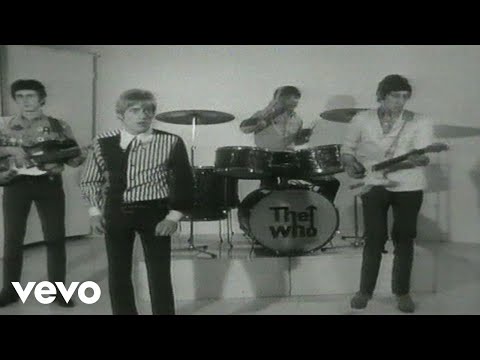
In mid-60s Britain, no one joined the dots between art and music more assiduously than The Who, bedecked in the arrows and roundels of their hi-vis pop art regalia, adapting the flags and medals of a crumbling empire to their own symbolic, sartorial, and gestural ends. Whether or not guitarist/songwriter Pete Townshend diligently took notes when attending a lecture given by auto-destructive artist Gustav Metzger at Ealing Art College, he certainly talked a good game. In Before I Get Old: The Story Of The Who, Dave Marsh contends: “Townshend, like Lennon and perhaps Davies, displayed a thorough familiarity with contemporary artistic theory, which can easily be seen in his immediate application of ideas derived from [Sir Peter] Blake’s pop art paintings… and in the use of the auto-destructive technique…”
Click to load video
Invoking Metzger’s auto-destructive ethos made the trashing of The Who’s equipment a legitimate art gesture in theory, even if some cynical journos and horrified musos remained resolutely unconvinced. “Anyway, Anyhow, Anywhere,” the band’s May 1965 second single, accordingly approximated the pinned-pupil aggression and bluster of The Who’s live set and the demeanor of their mod fan base, but also aped the sensationalist flash and immediacy of a particular strain of pop art, with its combustible tracery of Morse-code feedback: Roy Lichtenstein’s Whaam! set to music. “We play pop art with standard group equipment,” Townshend deadpanned to Melody Maker at the time.
Townshend’s art school peers Keith Richards and Ray Davies don’t twitch one’s art rock antennae to the same degree. For all that the Stones knocked about town with London art dealer Robert Fraser, and given that their seditious image was carefully fine-tuned by manager Andrew Loog Oldham, their R&B-rooted music was essentially traditional and reverential. However, “Paint It, Black” makes the art rock cut, proffering a rarefied nihilism that plummeted into a dangerously tempting realm of societal disengagement behind closed curtains, in a prescient shimmer of sitar.
Click to load video
Likewise, Ray Davies possessed a restless intelligence, a painterly eye, and a mannered archness (a Marble Archness, if you bought that label’s cheapo Kinks compilation albums) which betokened an art school background. However, it wasn’t long before the already jaded, distanced observer of “Dedicated Follower Of Fashion” was wistfully looking over his shoulder at the psycho-geography of an England which was a non-objective illusion to begin with. Nevertheless, before Davies’ reactionary inclination dug its heels in, The Kinks had already ticked the “novel sonic texture” box with Dave Davies’ game-changing, slashed-speaker guitar sound on 1964’s “You Really Got Me.” Furthermore, the sinuous raga tonalities of 1965’s “See My Friend” inarguably gazed to the far horizon.
The Velvet Underground
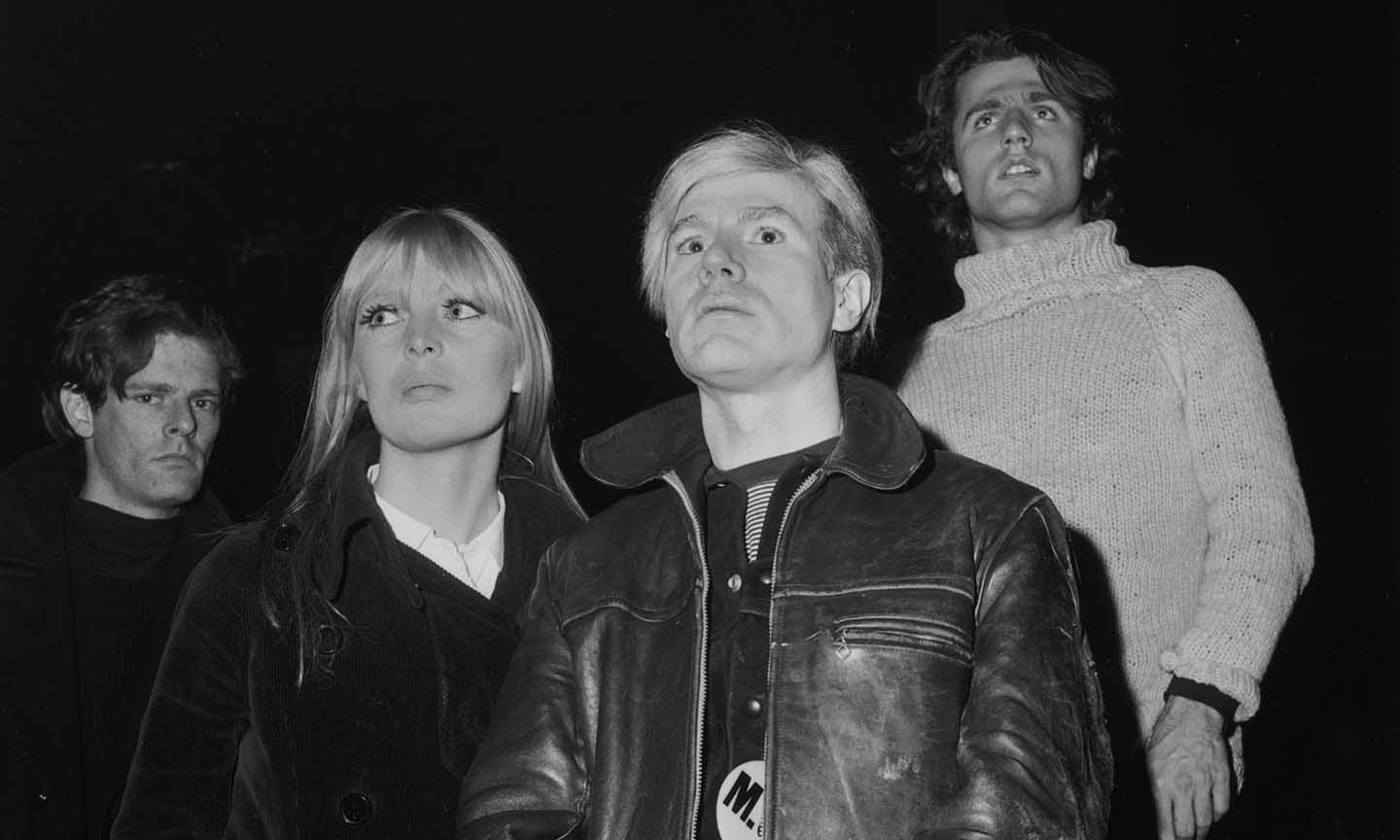
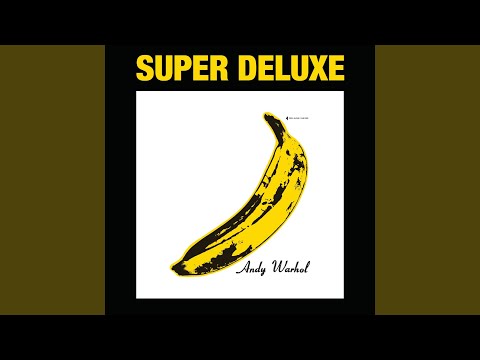
Meanwhile, in the US, The Velvet Underground boasted an explicit link to the art world by dint of being squired and theoretically managed by a genuine artist, Andy Warhol. Warhol designed the sleeve of their March 1967 debut album, The Velvet Underground & Nico, and was a galvanic, totemic presence during the recording. The album in question was exhilaratingly crude in sound and viscerally unflinching in subject matter, as Lou Reed matter-of-factly spat forth non-judgemental vignettes concerning drugs and dealers (“Heroin,” “I’m Waiting For The Man”), sado-masochism (“Venus In Furs”), mortality (“Black Angel’s Death Song”) and – lest anyone forget – unequivocal tenderness, with the Nico-sung “I’ll Be Your Mirror.”
Click to load video
With Warhol’s patronage, the Velvets moved in arty circles (and gobbled free food at society parties), but the band’s confrontational material, immoderate decibel count, and calculatedly unsweetened musicianship often engendered suspicion or revulsion. For many observers they were far too much, far too soon – though, of course, their eventual influence on the sound, look and content of alt.rock (which, after all, is only “art rock” with a single letter substitution, after all) would be incalculable.
Listen to the best art rock songs on Spotify.
In the early months of 1967, the Velvets and Warhol pulled apart. The band’s second album, January 1968’s White Light/White Heat, is ironically the one that truly cements their claim to art rock divinity: a black-hearted, clangorous, avant-garde masterpiece. Lou Reed, a BA graduate from the Syracuse College Of Arts And Sciences, would go on to deliver 1975’s noise-in-excelsis double-album, Metal Machine Music – a defining art gesture, which can be interpreted as a nose-thumbing contractual obligation and a cerebral ecstasy of dissonance with equal justification.
Psychedelia in the UK
In the UK, the onset of psychedelia in 1966/67 signified open season for bands with a plausible claim to art rock pertinence. (The late Patrick Lundborg defines the first flush of art rock as “an intellectualized form of psychedelia” in his book Psychedelia: An Ancient Culture, A Modern Way Of Life.) The Pretty Things, led by art school compatriots Dick Taylor and Phil May, evolved from compelling R&B degenerates into psych satyrs with the multi-faceted 1967 single “Defecting Grey” and 1968’s SF Sorrow, a far-sighted, diligently mapped concept album.
There was also The Creation, a sharp, antsy, Who-like quartet whose violin-bow-brandishing guitarist, Eddie Phillips, delivered the deathless quote: “Our music is red with purple flashes.” Their second single, October 1966’s “Painter Man,” richly took the piss out of starving-artist ideologues while also providing an excuse for vocalist Kenny Pickett to indulge in live onstage “action art” before setting alight to the canvas. (Ronnie Wood, a bona-fide art school attendee, was a later member of the band.)
Then, of course, there was The Pink Floyd, fronted at the time by a man whose painting aspirations were derailed by his regrettably brief music career, but who nevertheless applied an art approach to playing his mirror-disc-embellished Fender Esquire, espousing “texture rather than technique” (as Rob Chapman puts it in Syd Barrett: A Very Irregular Head). Intrigued by the bold initiatives of guitarist Keith Rowe, from committed experimentalists AMM, Syd Barrett ran a Zippo lighter up and down the neck of his guitar, plugged it through a Binson Echorec, struck out for the unknown, and trusted to providence on the early Floyd set-piece, “Interstellar Overdrive.” The version captured on the Floyd’s debut album, August 1967’s Piper at The Gates Of Dawn, achieves moments of free-falling transcendence even under the lights of Abbey Road Studio 3, and remains a visionary landmark of improvised music. (Twelve years later, with The Wall, Barrett’s erstwhile colleagues would literally build a wall between themselves and their audience – an art rock conceit if ever there was one.)
The Beatles lead the charge
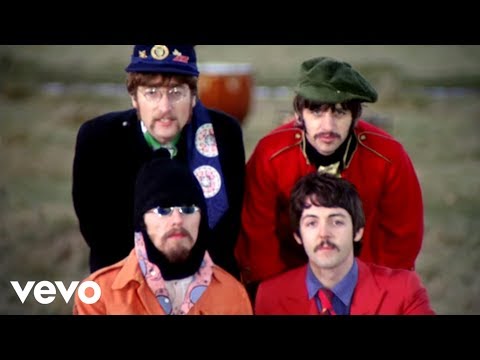
As was so often the case in the 60s, The Beatles had led the charge. “Tomorrow Never Knows,” from August 1966’s Revolver, was a properly avant-garde construct, wholly without precedent for a pop group. A collage of tape loops, a disembodied vocal channeled through a rotating Leslie speaker, a backward guitar solo, and a lyric derived from Timothy Leary and Richard Alpert’s book The Psychedelic Experience: A Manual Based On The Tibetan Book Of The Dead contributed to an arresting, groundbreaking sound picture. A number of elements fed into the band’s envelope-pushing desires during this period – not least Lennon’s embrace of happenstance; McCartney’s self-bettering interest in cutting-edge film, art, and literature; and producer George Martin’s unflappable skill as an interpreter and facilitator. February 1967’s unimpeachable double A-side, “Strawberry Fields Forever”/“Penny Lane,” constituted a heady elixir, bittersweet and opaque on one side and brightly hallucinatory on the other; but the apogee of an artfully surreal collective approach was arguably “Being For The Benefit Of Mr. Kite,” from June 1967’s epochal Sgt Pepper’s Lonely Hearts Club Band.
Click to load video
With a lyric cribbed almost verbatim from a circus poster purchased by Lennon from an antiques shop in Sevenoaks, on the same day as filming the video for “Strawberry Fields Forever,” the song required a suitably evocative, whirling, fairground backdrop, to which end George Martin sourced tapes of a steam calliope and, utilizing an audio equivalent of author William Burroughs’ “cut-up” technique, snipped the tape into pieces, threw them in the air and had engineer Geoff Emerick reassemble them where they fell. A genius move, albeit one which required further adjustment when it was discovered that some sections of the tape had been reassembled more or less in their original configuration.
Provocateurs and deconstructionists
Lennon would subsequently marry Japanese conceptual artist Yoko Ono, an abstract provocateur whose liberating influence should never be underestimated. However, with regard to artful tape editing and manipulation, it was Frank Zappa who punted the ball into the stratosphere on 1967’s Lumpy Gravy and 1968’s We’re Only In It For The Money – with due respect to avant-garde forebears such as Edgard Varèse, Karlheinz Stockhausen, and Henri Posseur.
Meanwhile, Zappa’s friend and occasional collaborator, Don Van Vliet, would in time eschew music altogether and pursue a career in painting – but not before completely rewiring all notions of structural logic in the antic guise of Captain Beefheart, goading a series of long-suffering but prodigiously gifted Magic Band line-ups into producing some of the most idiosyncratically constructed rock music ever recorded. The 1969 double-album, Trout Mask Replica, represents a hefty throwdown to this day.
In the combustible, politically polarised, Germany of the late 60s and early 70s, several crucial bands deployed avant-garde, deconstructivist principles. Faust, on their clear-vinyl, transparent-sleeved, self-titled 1971 debut album, assembled a cynically humorous if often indefinably threatening pyre from treated scraps of tape, disjointed snatches of dialogue, static-prickled firestorms of electronica, and queasy sing-song passages. The melody-averse mischief-maker Conrad Schnitzler, who formerly studied sculpture under the aegis of Fluxus artist Joseph Beuys, brought a multimedia sensibility and a determined ethos of “organized” noise to the early Tangerine Dream and Kluster. Meanwhile, NEU! reduced rock music to its most elemental, repetitive, and primal essence – thereby elevating it to a beautifully streamlined purity – and Kraftwerk outgrew rock’s conventional instrumentation and dress code to become man-machine avatars, the immaculately stylized synth pioneers of popular legend.
Above all, Can applied a high-minded discipline to the rejection of high-minded disciplines, with at least three members (keyboardist Irmin Schmidt, bassist Holger Czukay and drummer Jaki Liebezeit) consciously turning their backs on the perceived orthodoxy of classical, jazz, and even avant-garde antecedents. “Can are not a pop group,” Schmidt unconditionally stated, as David Stubbs recalls in his remarkable book Future Days. “It’s pop art. It’s art music.” Serendipitously, Can chanced upon two vocalists in succession – American sculptor Malcolm Mooney, impulsive and anarchic; and Japanese busker Damo Suzuki, blithely unconcerned by linguistic convention – who were uniquely able to give voice to Can’s fearless music in a manner that owed little or nothing to any discernible archetype.
The impetus to progress
It gets trickier when prog rock is brought into the equation. The impetus to “progress” was inherent in the description, yet there was something about the genre’s emphasis on grandstanding virtuosity which, ironically, often seemed too traditional and eager-to-please to qualify as “progressive” – let alone art rock.
Emerson, Lake & Palmer, for example, devoted a whole album to an appreciation of art – 1971’s Pictures At An Exhibition, an adaptation of Modest Mussorgsky’s 1874 classical piano suite – but they were playing to a different kind of gallery altogether. One could, however, make a case for King Crimson and Van Der Graaf Generator, who shared a seam of cloistered, brainy, malignant darkness that you just knew would follow its own hell-bent course whether or not you were intrepid enough to listen; while, conversely, putative Canterbury Scene artists such as the early Soft Machine, Kevin Ayers and (the not geographically relevant) Egg leavened their albums with knowing, esoteric or self-referential humor that nevertheless accompanied challenging, disconcerting interludes of fervid atonality.
For your pleasure: the rise of glam rock
It was actually in the UK singles chart of the early 70s that art rock was most overtly visible, in the idiosyncratic shape of Roxy Music. Even in the peacock context of glam rock, Roxy looked and sounded intoxicatingly exotic; and in vocalist Bryan Ferry and synth manipulator Brian Eno, they housed, unsustainably, two intractable personalities whose art studies (at Newcastle University and Colchester Institute, respectively) had a significant bearing on the band’s appearance and sound.
If Roxy Music’s early album covers and sartorial decisions flirted deliberately with kitsch and decadence, it was Eno’s experimental and flamboyantly non-musical input – at a time when “paying your dues” was perceived to be paramount – that represented the band’s most deliciously provocative aspect.
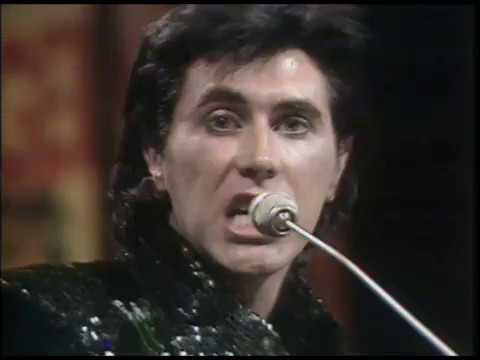
Between Ferry’s bendy enunciation, Andy Mackay’s cantering oboe, and Eno’s spurting electronics, it was as though a spaceship had crash-landed in the Top 5 when Roxy released their debut single, 1972’s “Virginia Plain.” Taken in tandem with the band’s first two albums, ’72’s Roxy Music and the following year’s For Your Pleasure, it was clear that a new entry had been deftly added to the audio-visual lexicon of chart pop. But within a year Eno had moved on, launching an ongoing, conspicuously fecund solo career as a recording artist, producer, and fountainhead of ideas and initiatives. His projects have ranged from assembling multimedia art installations and composing ambient albums, to contributing the start-up music for Windows 95. Tellingly, his name has been linked with some of the more artistically inclined pop/rock personages of the past 40 years. (Devo, Talking Heads, and David Bowie are particularly applicable in this regard, but see also Half Man Half Biscuit’s fond tongue-in-cheek, “Eno Collaboration.”)
Click to load video
Bowie was arguably the only chart mainstay in the early-to-mid 70s who presented a more enigmatic face to the world than Roxy Music, all the way from the humanoid boogie of the Ziggy Stardust era to the skeletal, modernist funk of Station To Station, so it seemed inevitable that his and Eno’s paths should cross.
The so-called “Berlin Trilogy” (the three albums on which Eno collaborated and recorded by Bowie in Berlin’s Hansa Tonstudio: 1977’s Low and “Heroes”, and 1979’s Lodger) bore the unmistakable influence of NEU!, Kraftwerk, and Cluster in the recondite, insular-yet-expansive instrumentals which predominated on the first two, but also proved influential in turn with their often abstract compositional and production methods. Furthermore, they were among the few artifacts by a member of the “old guard” not to be dismissed out of hand by Year Zero purists in the wake of the punk explosion of 1976/77.
Art punk: an impulse to shock and provoke
For all that punk appeared to espouse an anti-intellectual agenda, the impulse to shock and provoke was nevertheless consistent with art rock principles. Of the ostensible new wave, bands including Wire, Devo (so arty they had their own manifesto), The Clash, XTC, The Soft Boys, and Adam And The Ants all contained members who had attended art schools – as had Ian Dury, receiving first-hand tutelage from Peter Blake – while the managers of Sex Pistols and The Clash, Malcolm McLaren and Bernie Rhodes, were keenly aware of Situationist rhetoric. Meanwhile, the American electronic duo, Suicide, slotted into an avant-garde lineage that included Silver Apples, Bruce Haack, United States Of America, and 50 Foot Hose, but were nevertheless still sufficiently far ahead of the game as to engender/endure some horribly confrontational scenes when supporting The Clash on a 1978 UK tour.
Suicide were strong meat even in the comparatively enlightened environs of CBGB, the legendary US cradle-of-punk club run by Hilly Kristal at 315 Bowery in New York’s East Village. But with due respect to Television’s prickly beauty, the CBGB veterans who made the most enduring contribution to the art rock pantheon would be Talking Heads. Defined by David Byrne’s bookish, passive-aggressive persona and a propensity for jittery white funk with world music flavors, they pursued a distinctively eccentric course well into the 80s and enjoyed a particularly beneficial alliance with Eno, who produced three albums for them (1978’s More Songs About Buildings And Food, the following year’s unsurpassable Fear Of Music and 1980’s Remain In Light) and collaborated with Byrne on 1981’s momentous, sample-based My Life In The Bush Of Ghosts.
The art rock mindset manifested itself in the late 70s and early 80s via daring, sonically inquisitive, or lyrically abstruse post-punk and beyond-punk bands including Public Image Ltd, Australia’s The Birthday Party (featuring a young-but-not-callow Nick Cave), and The Fall – though Fall frontman, Mark E Smith, the man who wrote “Prole Art Threat,” really warrants a category all of his own. In America, loosely affiliated “no wave” performance artists and groups such as Teenage Jesus And The Jerks, James Chance And The Contortions, Mars, and DNA all pursued a bloody-minded, noncompliant but spirited agenda. All four bands were compiled on 1978’s No New York – a Brian Eno production, naturally – and their unruly example contributed to a trickle-down effect on subsequent noise adherents, including Sonic Youth, Swans, and Foetus, and industrial outfits such as Einstürzende Neubauten and Test Dept.
Again, playful art rock initiatives continued to crop up intermittently in mainstream pop, from The Flying Lizards’ skin-and-bone redaction of “Money” (1979) to Laurie Anderson’s encouragingly high-charting “O Superman” (a UK No.2 in October 1981), and Trio’s morosely parodic “Da Da Da” (1982). Kate Bush and former Genesis vocalist Peter Gabriel utilized cutting-edge studio hardware and video technology in the service of some palpably thoughtful, intelligent compositions, while Peter Saville’s elegantly modernistic artwork for Factory Records built upon the conceptual integrity of Hipgnosis’ sleeves in the 70s by establishing a coolly homogenous identity for the label’s acts.
Not to denigrate guitarist John Squire’s, Jackson Pollock-inspired, cover art for the self-titled 1989 debut album by The Stone Roses, but art rock’s next most significant metamorphosis was indicated by the formation of inscrutably compelling American bands the likes of Slint and Tortoise – tenebrous harbingers of so-called post-rock, with its emphasis on texture rather than technique. Does that sound familiar? With an entirely appropriate distaste for reductive labeling, many bands arbitrarily lumped together under the post-rock banner (Godspeed You! Black Emperor and Mogwai included) have reflexively shied away from the term.
Art rock in the modern era
In the last 20 years, the most high-profile adherents to an art rock ethos would have to be Blur, whose fitful desire to look beyond formulaic pop conventions spoke volumes about the knock-on effects of a bohemian background. (Damon Albarn’s father, Keith, ran the School Of Art And Design at Colchester Institute, while guitarist Graham Coxon had been an arts student at Goldsmiths College.) Albarn’s numerous, varied side projects – not least Gorillaz, the “virtual”, multimedia incentive co-created by Albarn with comic book artist/designer Jamie Hewlett – signify a healthily restless need for artistic reinvention and an insatiable thirst for new stimuli.
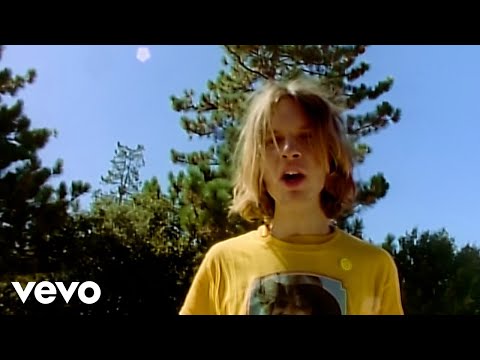
In the US, over a similar time frame, Beck Hansen has repeatedly displayed a quixotic disposition and an eagerness to experiment not just with sound, but also with the music medium itself (witness 2012’s Song Reader, an album presented solely as sheet music). With a mother, Bibbe Hansen, who starred in several Andy Warhol films, and a grandfather, Al Hansen, who was a member of the Fluxus artist network, Beck has controversial art in his bloodline. By gleefully smashing together elements of hip-hop, hardcore punk, threadbare folk-blues, parched country-rock, and lo-fi electronica, his best music eloquently testifies to the wisdom of breaking down (or blithely ignoring) the barriers.
Click to load video
The most fully realized art rock is compelled to indulge itself, and probably doesn’t care what you think… And, as befits any art-related endeavor, you might sometimes have to stand back to see it properly. There hasn’t been room in this discourse to salute oracular entities who also served, including The Residents, Jack Ruby, Destroy All Monsters, Annette Peacock, White Noise, Area, This Heat, Throbbing Gristle, The Raincoats, Pere Ubu, and The Pop Group… but we really ought to doff a hat in their direction before we go.
Browse our rock collection featuring limited edition vinyl and CDs here.
Continue reading...
0 Replies
·
2 views
Replies
Legacy View
Bill Pearis
Here’s a roundup of recent tour news. Check the Tour Dates category for more.
NICK HAKIM
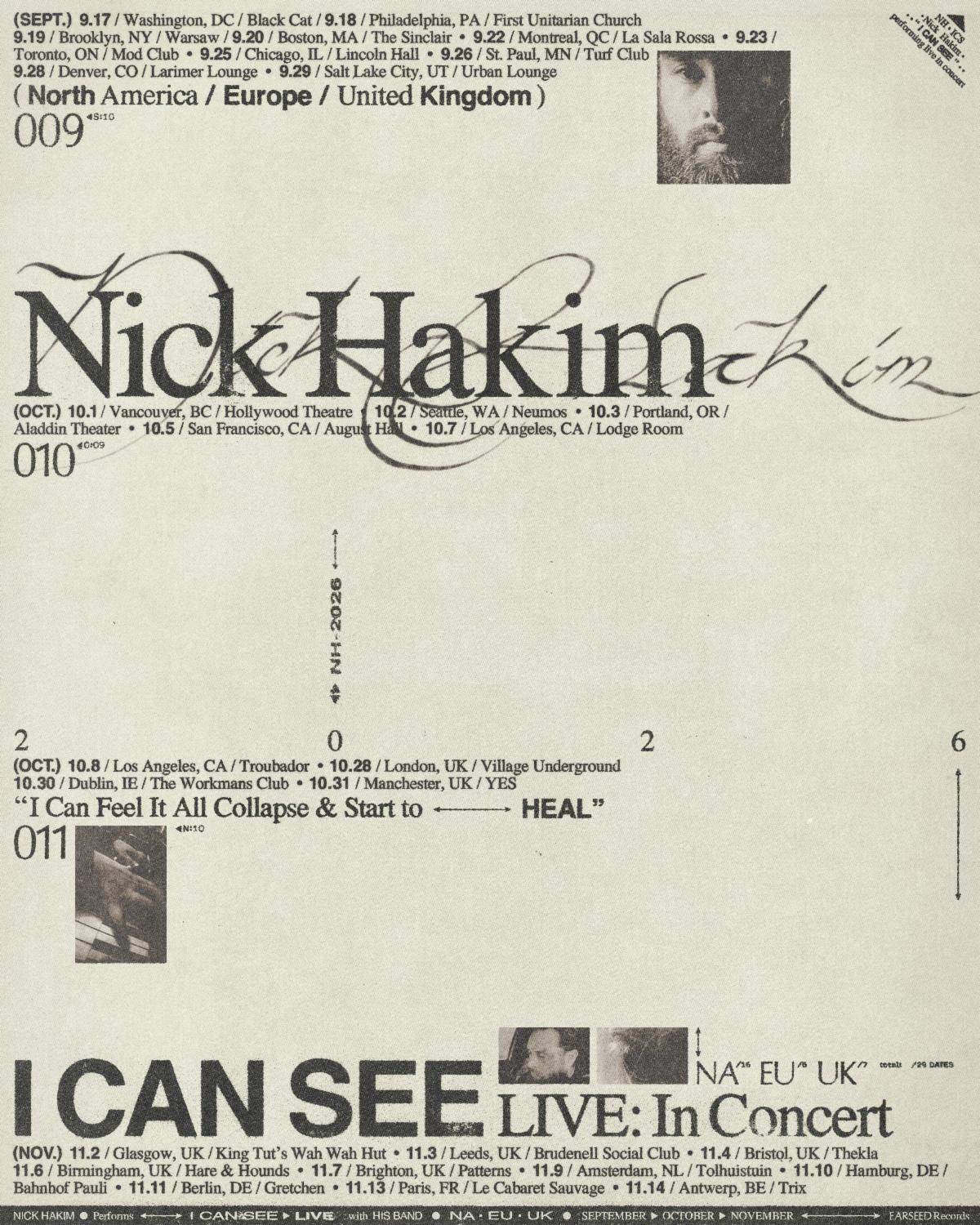
Nick Hakim will be touring this fall in support of his new album I Can See. Dates include Brooklyn club Warsaw on September 19.
SYLVAN ESSO
Sylvan Esso have announced a full band tour, beginning on October 1 in Atlanta and running through 2026 and into 2027.
LETTERKENNY LIVE
Great Canadian sitcom Letterkenny concluded its 12-season run in 2023 but the cast are reuniting for “Letterkenny Live,” a 2027 North American tour.
BEDOUINE
Bedouine is supporting excellent new album TITLE on tour this year — she plays Brooklyn’s National Sawdust on Thursday and just announced new tour dates which includes another NYC show at Le Poisson Rouge on November 10 with Steady Holiday.
JEFF TWEEDY / CASE OATS
Jeff Tweedy’s great solo album Twilight Override turns one in September, and he’ll continue supporting it on the road with a new round of solo shows. They happen in October and November, and he’ll be joined for them by Case Oats, the duo of Spencer Tweedy (his son) and Casey Gomez.
MÚM
Icelandic art-pop vets múm have announced new North American shows in support of History of Science which was their first album in 12 years. Dates kick off in NYC on September 24 at Le Poisson Rouge, and from there they head to Albany, Cincinnati, Chicago, Mexico City, and Guadalajara.
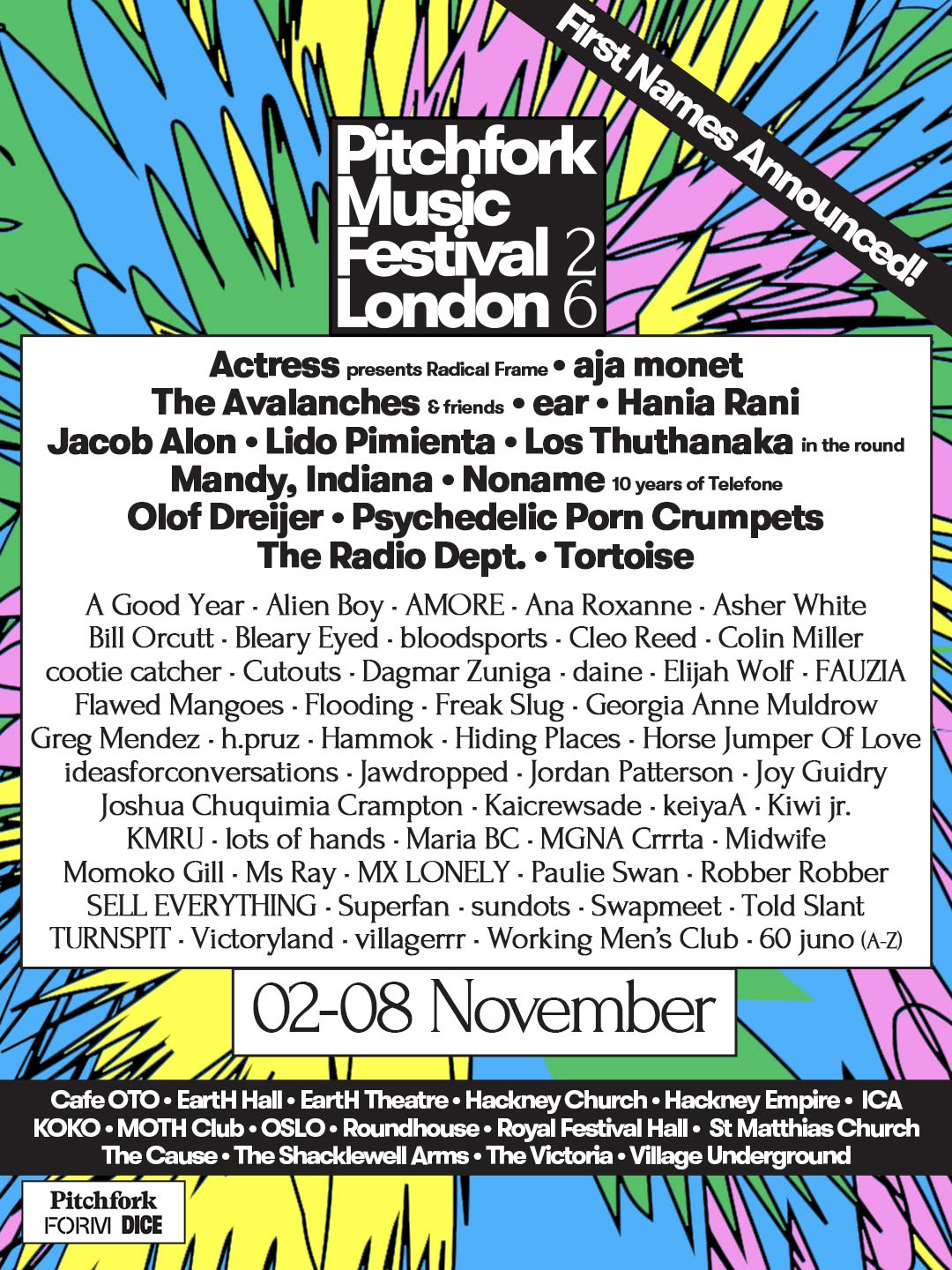
PITCHFORK LONDON (RADIO DEPT’S FIRST SHOW IN 8 YEARS) / PITCHFORK PARIS
Unlike the US edition (RIP?) that was only one day, Pitchfork’s music festivals in London and Paris happen over a week’s time at numerous clubs around each city. The London edition runs November 2-8 and the lineup includes The Avalanches, Sweden’s The Radio Dept (their first show in eight years!), Tortoise, Gred Mendez, Los Thuthanaka, Mandy Indiana, Robber Robber, Working Men’s Club, Actress, Noname, and more.
Pitchfork Paris, meanwhile, happens November 2-8 and the lineup includes Charlotte Adigéry & Bolis Pupul (who are playing NYC in September), AMORE, ear, Iceage, Robber Robber, and more.
LORD HURON / THAO
Lord Huron are on tour and opening is THAO who just released her first new music in six years.
HELADO TROPICAL
Helado Tropical, aka the duo of Helado Negro and Reyna Tropical, have announced a fall tour in support of their upcoming self-titled debut album. It begins in Washington, DC on October 23 and wraps November 26 in Mexico City.
THE MOUNTAIN GOATS SAN FRANCISCO RESIDENCY
The Mountain Goats have announced a six-show San Francisco residency happening at The Fillmore on November 15, 16, 18, 19, 20, and 21. Each night is a different theme which include “Stump the band” (Night 3), “Six Long Songs” (Night 4), and “Cast of Thousands” (Night 5).
RODRIGO Y GABRIELA
Rodrigo y Gabriela have announced a massive tour for their just-announced new album, with North American shows this fall and UK/EU dates in 2027.
—
Check our Tour Dates category for more.
Continue reading...
NICK HAKIM
Nick Hakim will be touring this fall in support of his new album I Can See. Dates include Brooklyn club Warsaw on September 19.
SYLVAN ESSO
Sylvan Esso have announced a full band tour, beginning on October 1 in Atlanta and running through 2026 and into 2027.
LETTERKENNY LIVE
Great Canadian sitcom Letterkenny concluded its 12-season run in 2023 but the cast are reuniting for “Letterkenny Live,” a 2027 North American tour.
BEDOUINE
Bedouine is supporting excellent new album TITLE on tour this year — she plays Brooklyn’s National Sawdust on Thursday and just announced new tour dates which includes another NYC show at Le Poisson Rouge on November 10 with Steady Holiday.
JEFF TWEEDY / CASE OATS
Jeff Tweedy’s great solo album Twilight Override turns one in September, and he’ll continue supporting it on the road with a new round of solo shows. They happen in October and November, and he’ll be joined for them by Case Oats, the duo of Spencer Tweedy (his son) and Casey Gomez.
MÚM
Icelandic art-pop vets múm have announced new North American shows in support of History of Science which was their first album in 12 years. Dates kick off in NYC on September 24 at Le Poisson Rouge, and from there they head to Albany, Cincinnati, Chicago, Mexico City, and Guadalajara.
PITCHFORK LONDON (RADIO DEPT’S FIRST SHOW IN 8 YEARS) / PITCHFORK PARIS
Unlike the US edition (RIP?) that was only one day, Pitchfork’s music festivals in London and Paris happen over a week’s time at numerous clubs around each city. The London edition runs November 2-8 and the lineup includes The Avalanches, Sweden’s The Radio Dept (their first show in eight years!), Tortoise, Gred Mendez, Los Thuthanaka, Mandy Indiana, Robber Robber, Working Men’s Club, Actress, Noname, and more.
Pitchfork Paris, meanwhile, happens November 2-8 and the lineup includes Charlotte Adigéry & Bolis Pupul (who are playing NYC in September), AMORE, ear, Iceage, Robber Robber, and more.
LORD HURON / THAO
Lord Huron are on tour and opening is THAO who just released her first new music in six years.
HELADO TROPICAL
Helado Tropical, aka the duo of Helado Negro and Reyna Tropical, have announced a fall tour in support of their upcoming self-titled debut album. It begins in Washington, DC on October 23 and wraps November 26 in Mexico City.
THE MOUNTAIN GOATS SAN FRANCISCO RESIDENCY
The Mountain Goats have announced a six-show San Francisco residency happening at The Fillmore on November 15, 16, 18, 19, 20, and 21. Each night is a different theme which include “Stump the band” (Night 3), “Six Long Songs” (Night 4), and “Cast of Thousands” (Night 5).
RODRIGO Y GABRIELA
Rodrigo y Gabriela have announced a massive tour for their just-announced new album, with North American shows this fall and UK/EU dates in 2027.
—
Check our Tour Dates category for more.
Continue reading...
3 Replies
·
6 views
is it just me or does every other ambient/lofi track have rain or wind samples in the background lately? like yeah theyre nice but its starting to feel like a crutch. are people just googling 'calm rain sounds' and slapping it under their beats or is there some deeper reason im missing? lowkey i get that it sets a vibe but it feels overdone at this point. tbh also if youre gonna use weather sounds at least make them subtle. theres this one track i heard where the rain was so loud it drowned out the melody and i couldnt tell if it was intentional or just bad mixing. anyone else feel this way or is it just me being picky about production trends? (also if you know good tracks that use weather sounds well im open to recs, maybe im just hearing the wrong ones)
0 Replies
·
0 views
Replies
Legacy View
ok so i know there are a TON of songs about the ocean and summer and sunset drives but what about **stargazing**?? like actual songs where its just about sitting outside late at night and watching the sky?? i feel like theres this whole mood that gets overlooked. weve got 'starry starry night' but thats more about van gogh than the actual stars. idk man i want some tunes for when youre out in the middle of nowhere and its just YOU and the universe. feel free to drop recs if youve got em also not tryna be cheesy here but if youve ever seen the milky way for real with no light pollution lemme know where bc ive only seen it once and it was WILD. anyway yeah songs about stars. go.
2 Replies
·
0 views
Re-watching movies isn't my thing but I can make an exception if the movie is very good. The only movie I've rewatched recently is Avengers : Infinity Wars. It's the best Marvels movies.
Do you like re-watching movies?
Do you like re-watching movies?
3 Replies
·
9 views
so i was messing around trying to find something chill for my desktop because i get distracted easily and i found out wallpaper engine has all these new 3d scenes now?? like you can have low-poly planets spinning or vines growing on your screen and idk why but it’s so cool?? i guess i havent used it in years and now i feel like im late to the party as usual it’s wild how much this stuff has leveled up... though im lowkey worried itll wreck my gpu usage even on 'low impact' settings lol does anyone else use this or am i just way behind the times again? also now im wondering if there are any indie devs making wallpapers that double as generative art (like... the kinda stuff you’d see at a net art gallery in the mid-2000s?? you know what i mean??) cause that’d be  chef’s kiss but maybe im overthinking this haha...
chef’s kiss but maybe im overthinking this haha...
0 Replies
·
1 views
Replies
Legacy View
every movie night needs at least one TERRIBLE choice whats the GOAT of so-bad-its-good flicks? cast your vote and argue why its a must-watch for cringe vibes.
whats the best bad movie to watch with friends?
0 votes total
0 Replies
·
0 views
Replies
Legacy View
like, i was blasting this one track earlier today on my way to grab groceries (yeah, riveting life i lead) and it hit *so* differently compared to when i played it at home. honestly something about the rhythm lining up with the road noise and the scenery whizzing by just makes it feel like the song was made for that exact moment and its not even a road trip song or anything, just a random indie track with some guitar and synths idk if its the bass vibrating through the car or the fact that youre kind of in this weird headspace when youre driving — half autopilot, half zoning out — but it always feels more cinematic even songs i dont normally care about suddenly feel epic when im doing 60 on the highway. anyone else get this or am i just weird for thinking my car is a better sound system than my actual speakers?
1 Replies
·
2 views
like, remember when bands would drop an album that was one big story or theme? i feel like that doesn’t really happen anymore ngl it was cool to sit down and listen to something that felt like a whole experience, not just a playlist of singles. now it’s all about the hits and tiktok clips. don’t get me wrong, some of those are great but... idk, it’s not the same. maybe i’m just old or too into my vinyl collection. anyway, do yall miss that or is it just me...
0 Replies
·
0 views
Replies
Legacy View
look we all know snacks are the best part of any trip. but whats the GOAT? salty, sweet, or something else entirely? gotta know what fuels everyone out there. do you stock up at gas stations or plan ahead?
whats the best road trip snack?
2 votes total
3 Replies
·
18 views

Staff member
No skips. No filler tracks. Every song belongs.
What's one rock, punk, metal, or alternative album you can listen to straight through without touching the skip button?
What's one rock, punk, metal, or alternative album you can listen to straight through without touching the skip button?
4 Replies
·
39 views
